A comparative morphology of trichobothrial bases in mygalomorph spiders and its significance for the phylogeny and system of the infraorder (Arachnida: Araneae: Mygalomorphae)
Keywords:
Arachnida, Araneae, Mygalomorphae, bothrial evolution, evolution, morphology, spidersAbstract
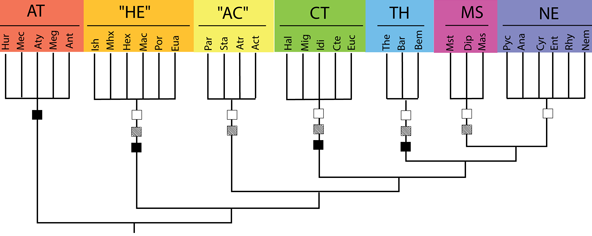
The morphology of trichobothrial bases was studied using scanning electron microscopy in 97 genera representing all 31 currently recognized extant families of the Mygalomorphae. The ancestral bothrial type in the infraorder is the ‘hooded’ bothria, characterized by clearly separated proximal and distal plates (a well-known ‘collar-like bothrium’ is one of its subtypes). The most advanced type is the solid, usually domed bothria with completely fused initial proximal and distal plates (a well-known ‘corrugiform bothrium’ is one of its subtypes). Several intermediate types, in which the border between the fused proximal and distal plates is still traceable, are also identified. Bothrial morphology supports general outlines of the Opatova et al. (2020) cladogram (e.g., the primary split of infraorder stem to the ‘atypoid’ and the ‘non-atypoid’ branches), as well as some of its ‘purely molecular-based’ to date clades (e.g., the placement of the Atracidae far outside of the Hexathelidae and together with the Actinopodidae). The ancestral hooded bothrial type is exclusive to ‘atypoids’ and predominant in ‘hexatheloids’ (both being basal phylogenetic lineages), whereas it is completely absent in ‘nemesioids’ (the distalmost lineage). The parallel continuous bothrial sequences from the ancestral hooded type to the advanced solid domed one, via intermediate ones, are observed in ‘ctenizoids’ and ‘theraphosoids’. The parallel replacement of the ancestral hooded bothria by the advanced solid ones appears to represent a general evolutionary trend in the infraorder Mygalomorphae. This trend is recognizable as well at the level of particular lineages (e.g., in ‘ctenizoids’), families (e.g., in Theraphosidae) and even subfamilies (e.g., in Ummidiinae). Strikingly similar patterns of parallel bothrial transformation have been documented in araneomorphs (e.g., in Dionycha and Araneoidea).
To cite: Eskov, K.Y., Guadanucci, J.P.L., Indicatti, R.P., Marusik, Y.M. & Zonstein, S.L. 2026. A comparative morphology of trichobothrial bases in mygalomorph spiders and its significance for the phylogeny and system of the infraorder (Arachnida: Araneae: Mygalomorphae). Israel Journal of Entomology 55, 73–146. https://doi.org/10.5281/zenodo.20829215
urn:lsid:zoobank.org:pub:0F7695A6-AFA9-406B-999A-31B4BE1B1ED3
Downloads
Published
Issue
Section
License
Copyright (c) 2026 Kirill Y. Eskov, José Paulo L. Guadanucci, Rafael P. Indicatti, Yuri M. Marusik, Sergei L. Zonstein

This work is licensed under a Creative Commons Attribution-NonCommercial-NoDerivatives 4.0 International License.